
Get Yourself Connected
#themodeway perspective on the DfT’s “Better Connected” strategy and what it means for developers.
Transport policy has finally caught up with placemaking
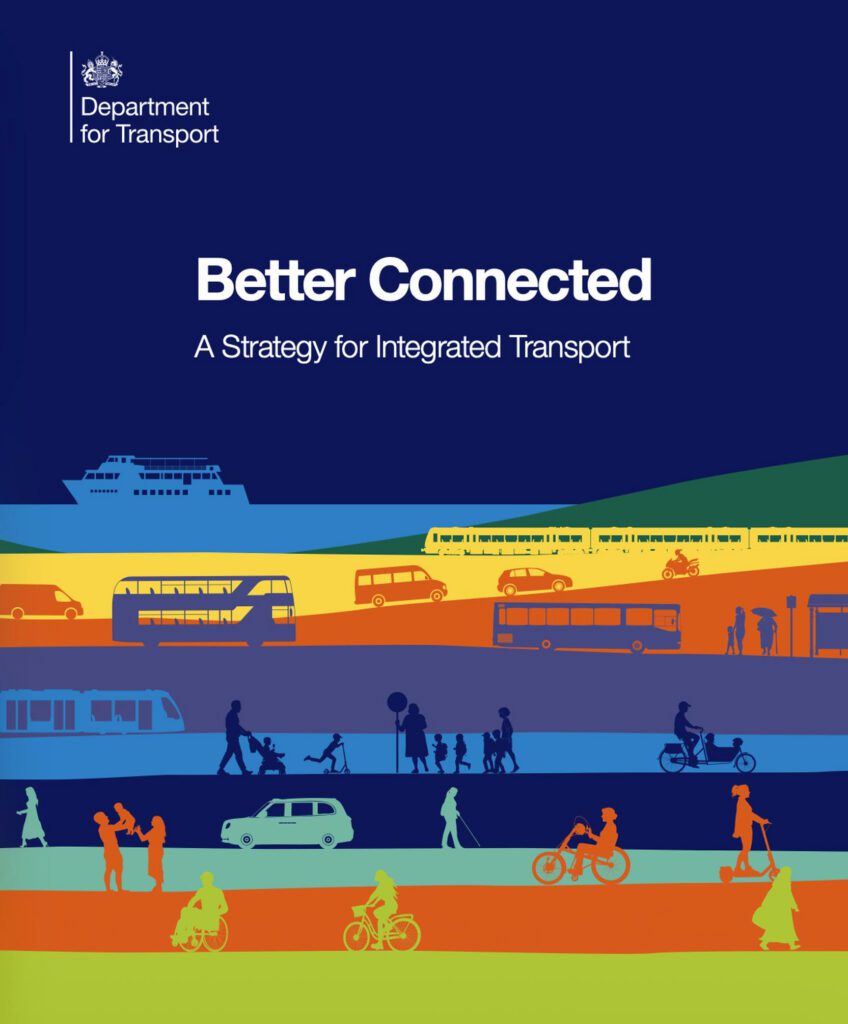
The Department for Transport’s newly published Better Connected strategy is not just a transport document, it is really a place-making manifesto.
At its core, it sets a clear direction:
Transport must be joined-up, people-focused and aligned with development.
That is exactly the territory where developer; and their advisors like mode transport planning, win or lose value.
What is “Better Connected” actually saying?
Three principles underpin the strategy:
- People first: transport must work for real lives, not models
- Better-connected places: transport as a driver of place, not an afterthought
- Partnership with local leaders: devolution + delivery
…and critically, eight priorities—of which three matter most to developers:
1. Align transport and development
Transport should no longer be reactive. It must shape where and how growth happens.
2. Empower local leaders
Decision-making is shifting to mayors and local authorities with funding certainty.
3. Optimise decision-making and appraisal
A clear signal: traditional modelling and appraisal approaches are under scrutiny.
#themodeway read: this is a Vision-led transport strategy in disguise
Strip away the policy language and this is what the DfT is really saying:
- Stop designing transport to mitigate development
- Start designing transport to enable great places
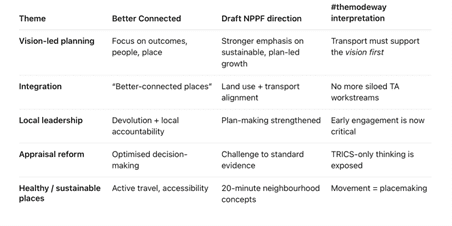
That is pure Vision-led thinking and directly aligned with the direction of travel in the draft NPPF (2025/26).
Better Connected × NPPF: the alignment is now explicit
The overlap is not subtle—it’s structural.
What this means for developers
1. The death of “standard” Transport Assessments
The days of predict →mitigate → justify are numbered.
Authorities, now backed by national policy, will increasingly expect:
- Narrative-led, place-based strategiesMulti-modal thinking from day one
- Evidence that supports outcomes, not just traffic flows
If your TA doesn’t tell a story about the place, it will struggle.
2. Early-stage strategy becomes the battleground
Because local leaders are being empowered, and funded, to shape transport networks:
- Pre-application engagement is no longer optional
- Schemes that align with local transport visions will move faster
- Schemes that don’t… simply won’t
The competitive edge shifts to early Vision-led input, not late-stage mitigation.
3. Integration unlocks land value
The strategy explicitly links transport to:
- Jobs
- Growth
- Access to opportunity
For developers, that translates directly into:
- Stronger planning cases
- Higher land values
- Reduced risk at committee
Transport should no longer be seen as a constraint: it’s a value driver!
4. Data, tech and simplicity will reshape expectations
From contactless ticketing to real-time data integration, the strategy pushes for:
- Seamless journeys
- Simplified user experience
- Digital-first transport systems
Expect increasing scrutiny on:
- Travel Plans
- Mode share assumptions
- “Real-world usability” of schemes
So… what should developers do now?
1. Start with the place, not the junction
Define:
- What kind of place are we creating?
- How do people move within it, not just to/from it?
2. Align with local transport visions early
Because those visions now:
- Have funding
- Have political backing
- Will shape outcomes
3. Upgrade your transport narrative
Move from: “The network can cope”
To: “This scheme creates a better-connected place”
4. Rethink evidence
Expect challenges to:
- TRICS-only trip generation
- Highway-capacity-led design
- Car-dominant assumptions
#themodeway conclusion
“Better Connected” is not a transport strategy…it is a growth strategy dressed as transport policy.
And for developers:
- Those who embrace Vision-led, integrated, place-first transport will unlock sites faster and with more value.
- Those who stick to traditional TA thinking will increasingly find themselves out of step with policy, and refused accordingly.
Final thought
If the NPPF set the direction… Better Connected is the delivery manual.
And the message is clear: Developers need to get themselves connected …or get left behind!
Back To News


Sign up to our Email Marketing
Sign up to stay in the loop with the latest updates, job opportunities, and insights from the team.